Forehead or back of the head? Testing an EEG headband design on real recordings
Contents
Entrain A0 is an open two-channel EEG headband built for alpha neurofeedback. It was designed with both channels on the forehead (Fp1 and Fp2), the easiest place to put dry electrodes. Before drawing the circuit board, we tested that choice on real brain recordings. The forehead turned out to be the wrong place for alpha, so the design now moves one channel to the back of the head.
The test#
We used the PhysioNet EEG Motor Movement/Imagery database (Schalk et al., 2004), which has one minute of eyes open and one minute of eyes closed for each person. We took the first six subjects. Each recording went through the headband's own software: the browser viewer resamples it to 250 Hz, packs it into the same Bluetooth frames the headband sends, and runs it through the same decoder, filters and neurofeedback engine. We compared electrode pairs on the forehead with a pair at the back of the head.
Alpha (8–12 Hz) is the rhythm that grows when you close your eyes and relax. It is what alpha neurofeedback trains.
| Electrodes | Alpha share of the signal, eyes closed (mean of 6) | Increase when the eyes close (geometric mean) |
|---|---|---|
| Fp1–Fpz (forehead) | 5.7 % | 1.49× |
| Fp2–Fpz (forehead) | about 6 % | 1.90× |
| Fp1–Fp2 (forehead) | 6.6 % | 1.80× |
| O1–Cz (back of the head) | 53 % | 4.09× |
On the forehead, closing the eyes changes alpha very little; for one person the change was 1.10×. At the back of the head it is large and obvious. Re-referencing the forehead electrodes in software doesn't fix this.
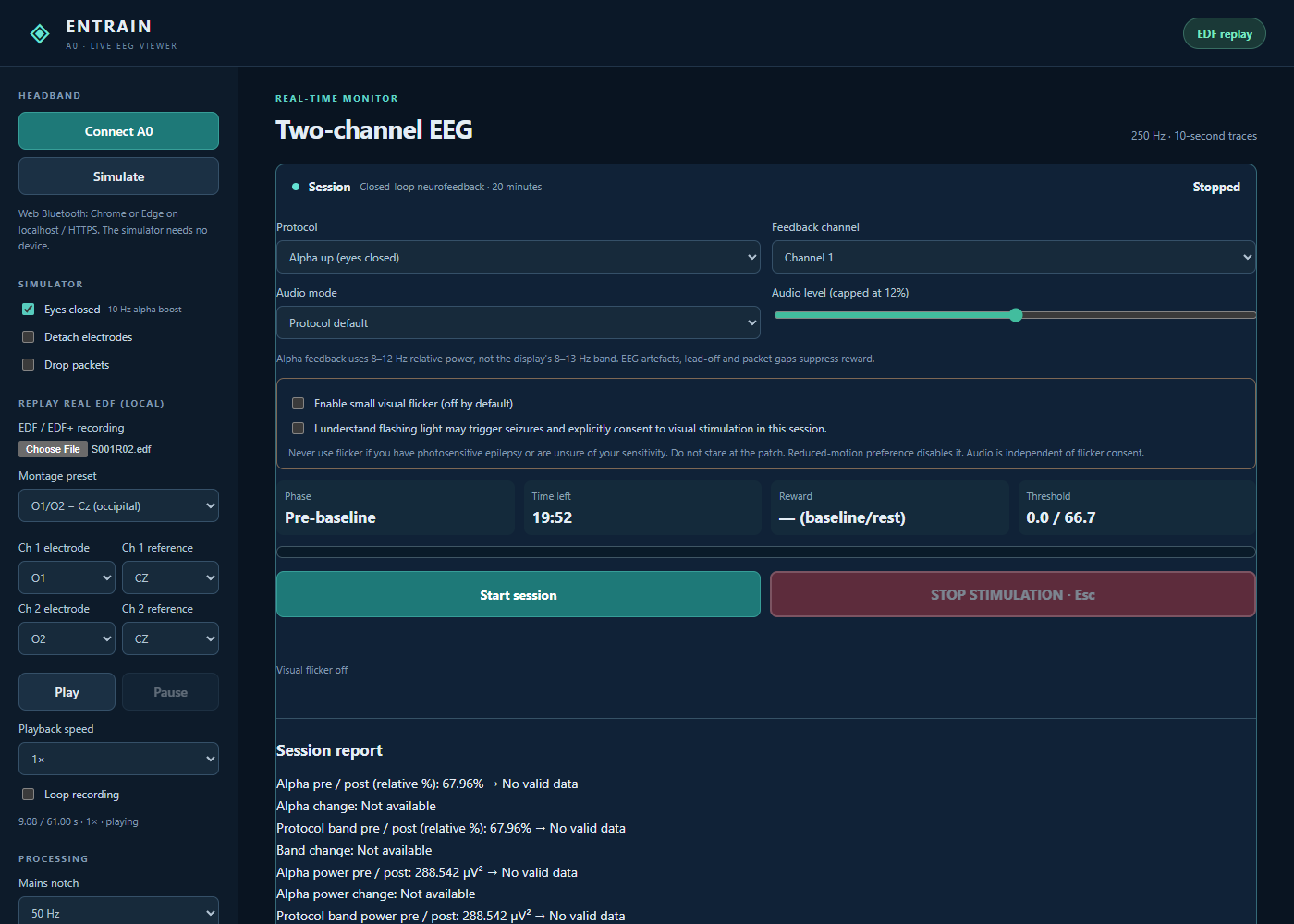
The numbers were checked two ways. The viewer's TypeScript pipeline and an independent Python/SciPy analysis agree on 312 measurements within 2 %. A browser test also loads the real file into the viewer and reads 65 % alpha at O1–Cz against 4.5 % at Fp1–Fpz.
The test exposed a second issue. The viewer's artifact filter used a fixed 150 µV limit to reject blinks and movement. At the back of the head, real eyes-closed alpha exceeds that limit, so for two of the six people the filter blocked the reward 89 % of the time. The filter is being reworked to adapt its limits per person and to detect blinks from the forehead channel.
The design change (rev B)#
- Channel 1 stays on the forehead (Fp1). It catches blinks, so the software knows when to ignore the other channel.
- Channel 2 moves to O1, at the back of the head, with an Ag/AgCl comb electrode whose pins reach the scalp through hair. A forehead-only version remains possible as a factory option.
- The front end chip stays the same, one TI ADS1292R. A four-channel chip and a switchable channel were considered and rejected for this revision.
- The same electrical safety rule applies to the new electrode: two pulse-rated 1 MΩ resistors in series, with ESD protection between them. The worst-case current under a single component fault is 6.3 µA, under the 10 µA benchmark.
- The body-voltage feedback loop is still stable. It cancels mains hum through the bias electrode; the new electrode changes its paths, so it was simulated again in ngspice. All 486 combinations of electrode contact quality, amplifier speed and skin capacitance are stable, with a phase margin of 92.7–96.7° (45° is the usual minimum).
- Also fixed in this revision: the power button now has a connection to the processor, so it can switch the headband off and confirm Bluetooth pairing.
What this does not show#
- These are research-grade wet electrodes in a lab recording, not our dry electrodes on our board. The rear comb electrode's real contact quality has to be measured once boards exist.
- Six people from one dataset is enough to show the direction clearly, not to state population figures.
- Nothing here shows that neurofeedback or 10 Hz entrainment works. It shows where the headband has to listen for the signal those methods rely on.
Data: Schalk G. et al., "BCI2000: A General-Purpose Brain-Computer Interface System", IEEE TBME 2004; Goldberger A. et al., "PhysioBank, PhysioToolkit, and PhysioNet", Circulation 2000. Dataset: physionet.org/content/eegmmidb/1.0.0.
One person, many companies, one coin. Every project I build sends a share of its revenue back to buy $BERLIAN on the open market, and every buy is published with its transaction.
More from Gor Berlian
CNC foam-panel router: assembly in 42 pictures
42 steps, each with a picture of the whole machine and a close-up of the parts added. English and Indonesian.
1,008,000 gravity
TradJS 4.7.0 in testing: 1,902 tests and 118 browser steps on the development branch
Repository: https://github.com/7flash/TradJS · On npm today: tradjs 4.6.5 · Tested here: the 4.7.0 development branch, 19 November 2026, Bun 1.4.3 on Windows 11.
The Plain Web Stack
TradJS, sqlite-zod-orm and measure-fn: what they are, how they are tested, and when to use them. A short book, November 2026.