Entrain: an open studio for beat sounds, measured as it plays
Contents
Entrain is an open-source browser studio for binaural and monaural beat sessions, plus a desktop player for Windows and a planned two-channel EEG headband. Its rule: say only what the physics and the published evidence support, and check every claim the software makes about its own sound with a measurement.
The evidence, in one line. Binaural beats are a real perception: two slightly different tones, one per ear, are heard as a slow wavering. Studies of whether they entrain brain waves, or improve focus, sleep or mood, are inconsistent. Entrain makes no medical or performance claims.
What works today#
A catalogue of 188 tracks, each with a plain description#
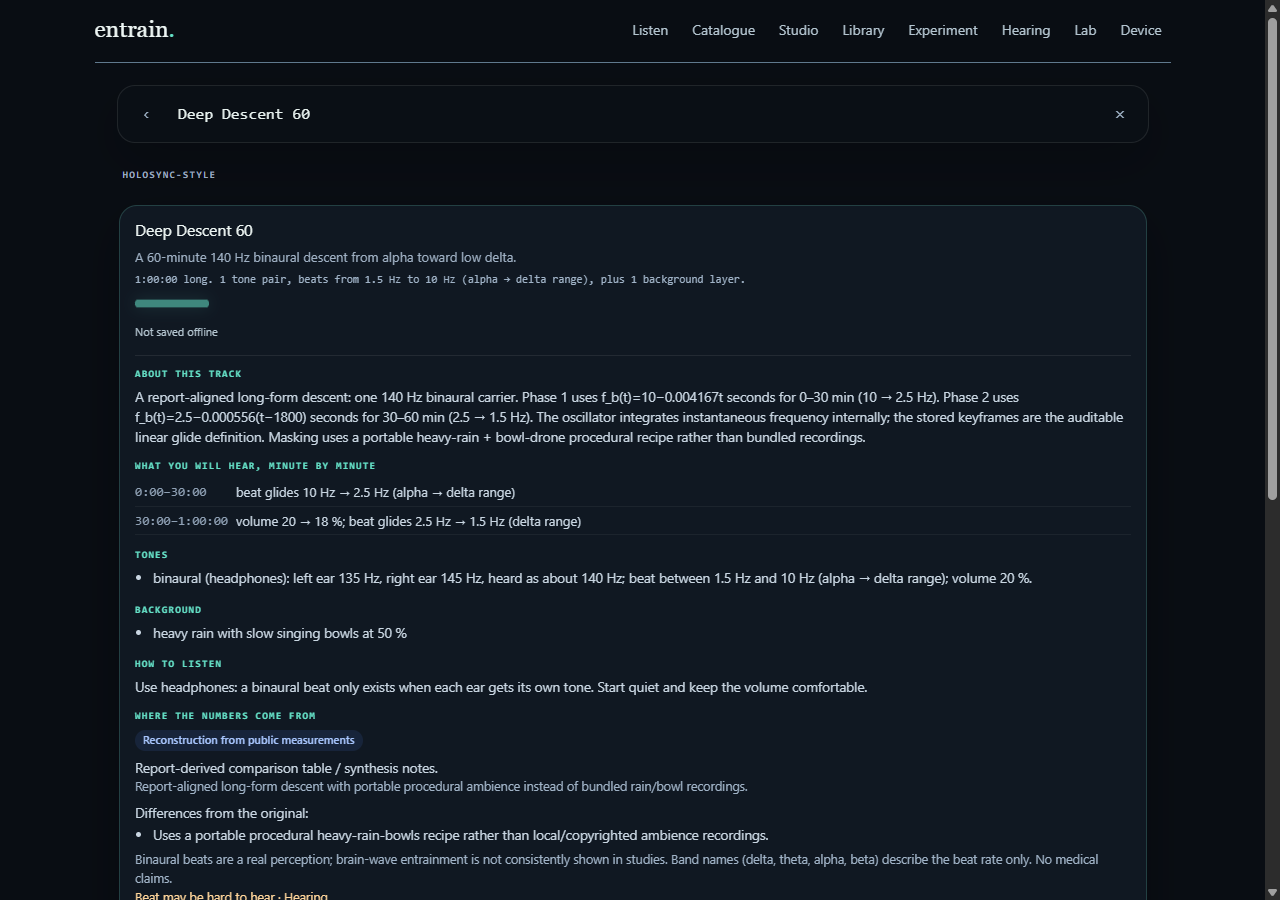
- Holosync-style descents: a single tone pair under synthesized rain and singing bowls. No recordings; everything is generated in the browser.
- Gateway-style tracks: 45 tracks follow published frequency analyses of the originals, stage by stage, using no original audio or voice.
- Explanations: every track says what you will hear, minute by minute, where its numbers come from, and how it differs from the original it is modelled on.
Every track plays at the same loudness#
Each built-in track gets one volume correction. To check it, we recorded the browser's real output for 25 tracks and measured it with the broadcast loudness standard (ITU-R BS.1770):
| Before | After | |
|---|---|---|
| Loudness range across the tracks | -40.0 to -28.3 LUFS | -33.6 to -31.7 LUFS |
| Within ±1.5 LU of the target | 25 of 25 | |
| Clipping | none | none |
Hear it for yourself, and test it on yourself#
- A hearing page: an adaptive listening test finds the slowest and fastest beats you can pick out at four tone pitches. It starts with a published headphone check (Woods et al., 2017). The studio then warns you next to Play when a track's beat may be hard for you to hear.
- A blinded self-experiment: each session plays either the real track or a sham with the beat removed, and you aren't told which. Afterwards you rate the session and do a 3-minute reaction-time test. At the end the page reveals the order and compares the two. "No difference" is a possible result, and it says so. Recorded in the browser, the real track and its sham measure the same loudness (-29.1 against -29.1 LUFS).
Works on a phone, in the background, offline#
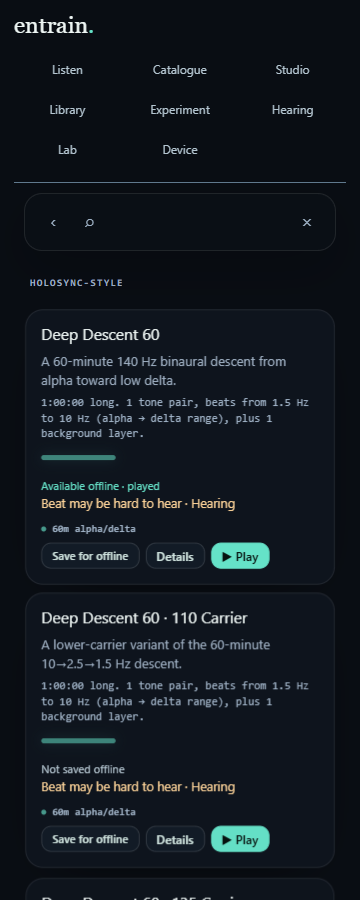
- On a phone, sessions keep playing when the tab is hidden, with lock-screen controls.
- The studio installs as an app, and tracks you've played or saved play with no network.
- Every page fits a 360 px screen.
An EEG lab and a device simulator#
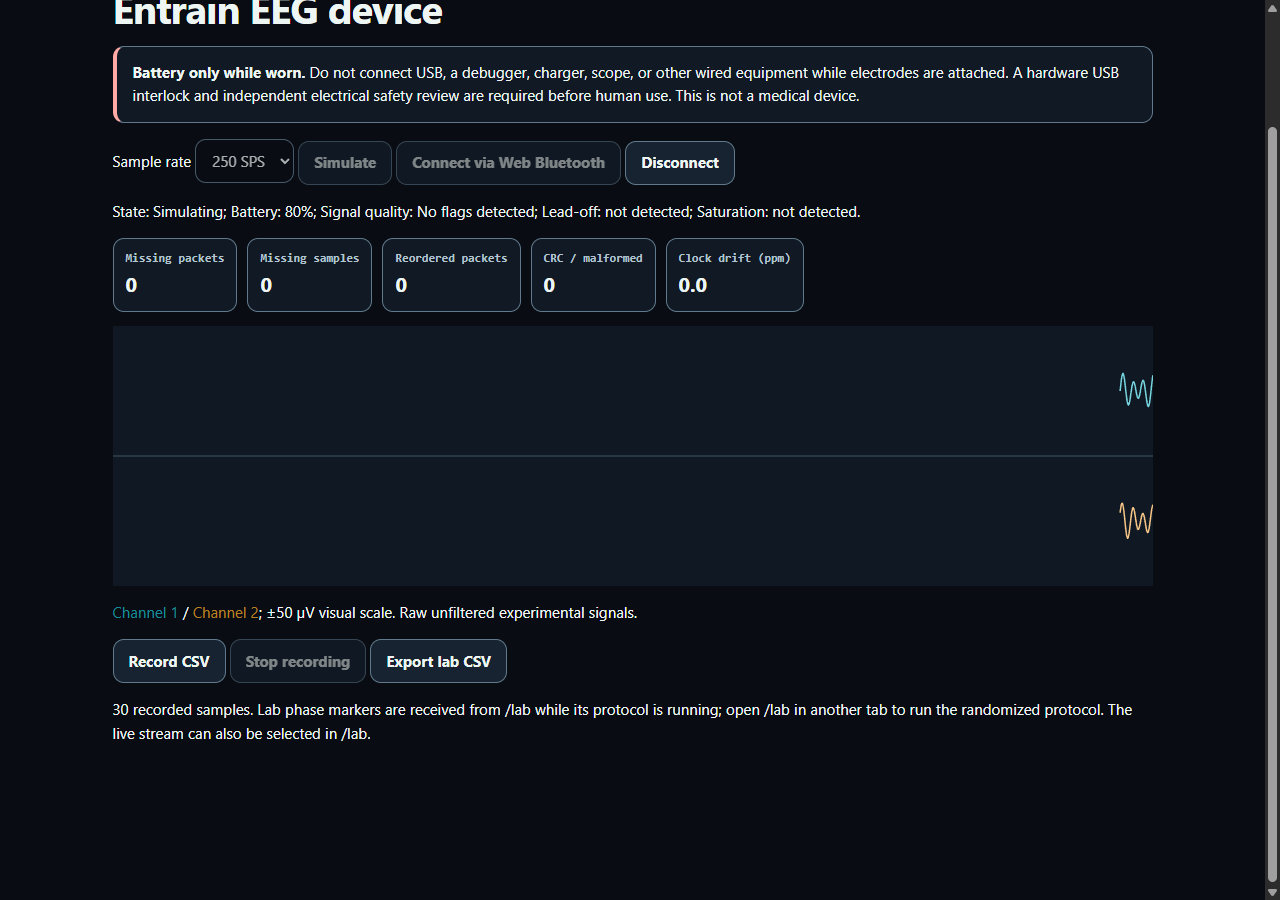
The headband is not built yet. The device page shows its data path with a simulator: two channels, packet-loss and clock-drift counters, and recording to the lab's format. The lab includes a pre-registered steady-state experiment that compares four sounds at a 40 Hz rate: binaural, monaural, pulsed, and a sham. It is designed so that it can come out negative.
How it is tested#
The project measures what it plays, not only what its code says:
-
Play-probe opens a track in a real headless Chrome, records the engine's final output sample by sample, and checks it against the track's script. It checks:
- the right tone in each ear, and clean binaural separation;
- loudness, clipping and gaps;
- pulsing in each ear.
It has caught real defects that unit tests missed. One was a 6 dB level mismatch between the experiment's four sounds, which would have biased the result.
-
Page tests drive the main flow of every page (11 flows) in headless Chrome at desktop and phone width. They fail if any sound bypasses the volume guard. The offline test once passed while not truly offline, because its network switch didn't reach the offline helper; it now cuts both.
-
Unit tests: 190 pass.
Safety#
- All sound passes through one guard: a -3 dBFS ceiling, fades, and a quiet start.
- The app can't measure the sound level at your ears, so start with your device volume low.
- The headband is not safe to wear until its electrical safety review and fault tests are done.
What's next#
- A public Entrain Studio website, with plain text labels in place of unclear symbols.
- The desktop player with the same rain and bowls, tuned for speakers (a monaural version).
- The Entrain book: the physics, the evidence, and how the project tests itself.
One person, many companies, one coin. Every project I build sends a share of its revenue back to buy $BERLIAN on the open market, and every buy is published with its transaction.
More from Gor Berlian
CNC foam-panel router: assembly in 42 pictures
42 steps, each with a picture of the whole machine and a close-up of the parts added. English and Indonesian.
1,008,000 gravity
TradJS 4.7.0 in testing: 1,902 tests and 118 browser steps on the development branch
Repository: https://github.com/7flash/TradJS · On npm today: tradjs 4.6.5 · Tested here: the 4.7.0 development branch, 19 November 2026, Bun 1.4.3 on Windows 11.
The Plain Web Stack
TradJS, sqlite-zod-orm and measure-fn: what they are, how they are tested, and when to use them. A short book, November 2026.